Fight against Serbian World is fight for democracy and sovereignty
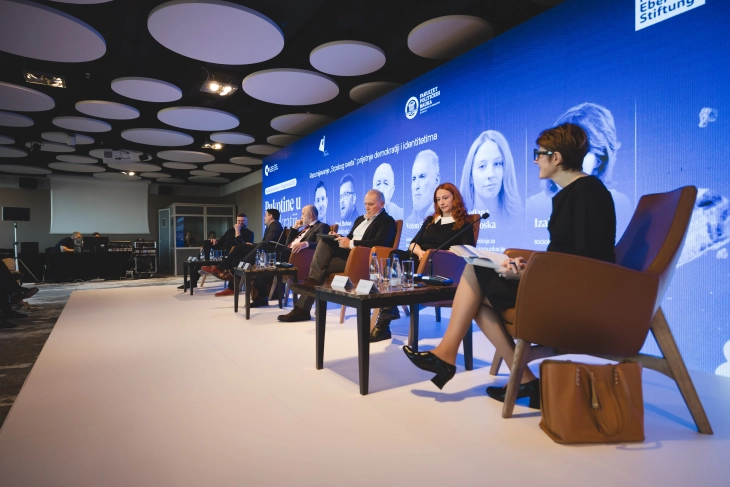
Podgorica, (MINA) – The ideology of the “Serbian World” is a continuation of the Greater Serbian project from the 19th century, and countering this idea in Montenegro requires emphasizing the Montenegrin national question and address the role of the church as one of the basic preconditions for stability.
This was emphasized during the panel “Understanding the “Serbian world”: Threats to Democracy and Identities” held during the regional plenum “Cracks in Democracy: Nationalism and Clericalism in the Western Balkans”, organized by the Center for Civic Education (CGO), the Regional Academy for the Development of Democracy (ADD) from Novi Sad, the Faculty of Political Sciences of the University of Sarajevo (FPN) and the German Friedrich Ebert Foundation (FES).
Director of the Western Balkans Network, Dr. Boban Batricevic, said that the ideology of the “Serbian World” is a continuation of Greater Serbian project from the 19th century, and unlike “Homogeneous Serbia”, there is no document outlining a work plan, since it is hidden, which he described as perverted genius.
According to him, this ideology controls 49 percent of the territory of Bosnia and Herzegovina (BiH), has a historical foothold in Montenegro, and can rule the entire state apparatus, unlike in BiH, and in Kosovo it is only symbolically present today.
Batricevic pointed out that the challenges for the Montenegrin nation lies in its size hich limits its ability to control state institutions, which should deal with the cultivation of the national identity.
Serbian historian, Dr. Milivoj Beslin, said that from Serbia’s point of view, the idea of “Serbian World” is not new, but only the terminology has changed, and that in those concepts it is necessary to gather all Serbs in one state.
He pointed out that the Greater Serbia project has tactically abandoned the pursuit of the territory, but implements a doctrine of limited sovereignty over neighboring states.
“Borders are not directly challenged, but the sovereignty of these state is fundamentally undermined, so Vucic is not only the President of Serbia, but the leader of all Serbs in the region. The people are the bearer of sovereignty, so Vucic positions himself as the bearer of sovereignty in Serbia, Montenegro, Bosnia and Herzegovina, and even considers himself the bearer of sovereignty in part of Croatia as well”, said Beslin.
Professor at the Faculty of Political Sciences of the University of Sarajevo, Sacir Filandra, said that BiH has been an object of the “Serbian World” for the last 150 years.
In his opinion, “Serbian world” and Greater Serbia are not synonymous.
“The Greater Serbia project has definitely failed as a state project, it is difficult for its supports to admit this, but it has failed. The “Serbian World” emerges as a cultural substitute adapted to the new geopolitical circumstances in Europe and is the result of the defeat of Greater Serbia”, said Filandra.
Writer, journalist, politician and civil society activist from Kosovo, Veton Surroi, believes that Serbia is closer to Russia today than when it became a candidate for EU membership.

He also stated that Serbia is now a greater destabilizing factor in the region than it was when it opened negotiations.
Strategic communications consultant and former adviser to the Prime Minister of North Macedonia, Svetlana Siljanoska, said that in North Macedonia they don’t hear much about the “Serbian World” and that currently the Russian narrative is much more present.