Social dialogue key to final stage of EU negotiations
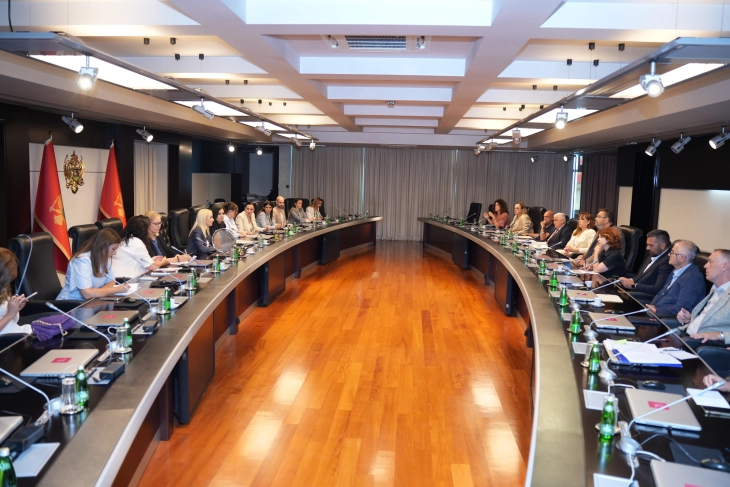
Podgorica, (MINA-BUSINESS) – It was stated at a thematic Cabinet meeting that Montenegro has fully met the requirements of the closing benchmarks under Chapter 19 – Social Policy and Employment, with participants emphasizing that social dialogue is crucial for the successful continuation of European integration.
Minister of Labour, Employment and Social Dialogue Naida Nisic and Minister of European Affairs Maida Gorcevic organized the thematic meeting, which brought together representatives of the European Union Delegation to Montenegro and the country’s representative social partners: the Montenegrin Employers’ Federation (UPCG), the Union of Free Trade Unions of Montenegro (USSCG), and the Federation of Trade Unions of Montenegro (SSCG).
According to a press release from the Government, representatives of the EU Delegation congratulated Montenegro on the closure of Negotiating Chapter 2 (Freedom of Movement for Workers), while particularly highlighting the significant progress made under Chapter 19 (Social Policy and Employment), which is considered one of the most extensive and demanding chapters in the accession negotiation process.
Minister of European Affairs Nisic said that a set of reforms in labour legislation and the labour market had been implemented in the previous period, highlighting the importance of strengthening the capacities of labour inspections, as well as occupational safety and health protection.
She added that, thanks to a comprehensive reform, a modern labour relations system aligned with the EU acquis and the standards of the International Labour Organization (ILO) had been established.
Minister of European Affairs Gorcevic said that the negotiation process as a whole, as well as social dialogue as an integral part of it, are connected by a common principle.
“The belief that reforms only make sense if they are implemented together with those they affect, and that every institution, every social partner, and every citizen is part of this journey,” Gorcevic said.
Deputy Head of the Cooperation Section at the EU Delegation Liselotte Isaksson said that, as part of the EU accession negotiations, Montenegro must demonstrate clear and measurable strengthening of social dialogue at all levels.
“Social dialogue should be based on facts and analysis, and partners should strive for greater mutual understanding, for the benefit of all stakeholders,” Isaksson said.
She encouraged all partners to fully commit to meeting the obligations undertaken in the context of EU integration and reiterated that the European Commission and EU member states will continue monitoring progress in this area even after Chapter 19 is closed.
SSCG Secretary General Dusko Zarubica said that the Confederation of Trade Unions, as a representative social partner with decades of experience at the national level, remains committed to supporting EU integration and further strengthening social dialogue as one of the Union’s important achievements.
UPCG representative Slavisa Scekic said that the coming period must be marked by greater sensitivity to the needs of the business sector, as adapting to the EU single market will be a difficult and turbulent process, but one that can nevertheless be successfully completed.
The meeting concluded that the Ministry of Labour, Employment and Social Dialogue will continue working diligently to strengthen institutions, improve workers’ rights, and create a safer, fairer, and more inclusive labour market.


