Nationalism and abuse of religion stand in way of the region’s development

Podgorica, (MINA) – Nationalism and abuse of religion for political purpose are undermining the democratic foundations of the region and distancing it from European values, while solutions are not as simple as populists try to present them. This was emphasized at the opening of the regional conference “Cracks in Democracy: Nationalism and Clericalism in the Western Balkans”, organized by the Center for Civic Education (CGO), the Regional Academy for the Development of Democracy (ADD) from Novi Sad, the Faculty of Political Sciences at the University of Sarajevo (FPN) and the German Friedrich Ebert Foundation (FES).
German Ambassador to Montenegro Peter Felten assessed that the themes of this year’s regional plenum – nationalism and clericalism – are among the key issues affecting peace and stability of the Western Balkans, the EU accession perspective of the region’s countries, and Europe as a whole.
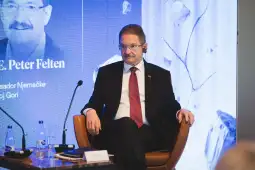
Felten pointed out that nationalism is the opposite of patriotism and that it brings intolerance, division and rejection of “others”, either internationally, within the EU, or within individual societies, stating that nationalism clearly obstructs regional development.
He highlighted the manipulation of European values by opponents of EU integration, stressing that the misrepresentation of the EU principles has become a weapon of those who oppose to EU membership and that the result of that propaganda is a decline in support for the EU in recent months in Montenegro.
Executive CGO director Daliborka Uljarevic pointed out that the title of this year’s plenum is not only a diagnosis of the state of democracy in the region, but also a call to action.

“These cracks are not abstract, they are in institutions that are losing the citizens’ trust, in education that retreats before myths, and in societies where fear and faith in authority increasingly replace critical thinking and freedom. Democracy in the Balkans is not cracking because of weak laws, but because of weak values, and it is time to make them strong again”, said Uljarevic.
The Dean of the Faculty of Political Sciences of the University of Sarajevo, Sead Turcalo, believes that the region is exposed to the “danger of simplicity” driven by nationalists and populists who offer overly simple answers to very complex issues.
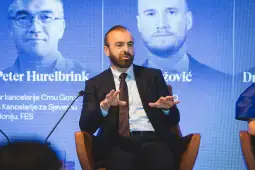
According to him, those who seek simplicity cannot respond to pluralism and dialogue and “that’s why we should not close those cracks, but fill them with dialogue”.
ADD Executive Director Balsa Bozovic reflected on the situation in Serbia and the tragedy in Novi Sad, adding that there is consensus that Serbian President Aleksandar Vucic was personally responsible for that tragedy.
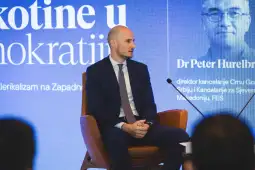
Director of the FES Office for Montenegro, Serbia and the Office for North Macedonia, Peter Hurelbrink, said that over the years the regional plenum has become an important opportunity to exchange views on the most important issues facing societies in the Western Balkans.