National Bank of Austria supports CBCG reforms
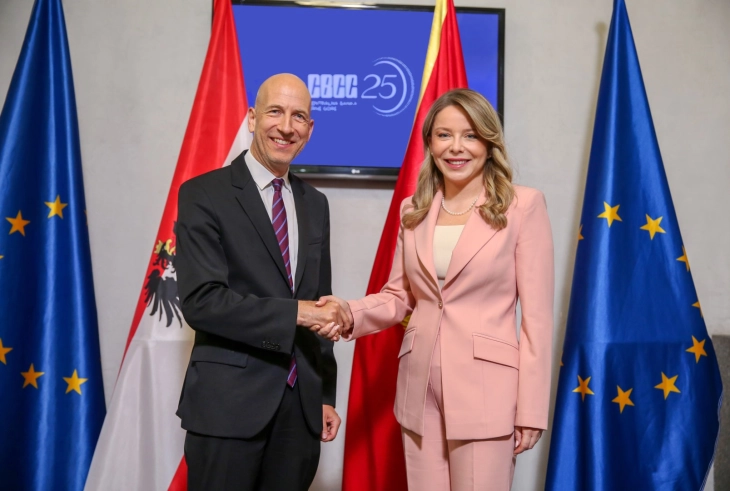
Podgorica, (MINA-BUSINESS) – According to its Governor Martin Kocher, the National Bank of Austria (Oesterreichische Nationalbank - OeNB) strongly supports the Central Bank (CBCG), particularly in the area of financial and payment system integration.
He said during his visit to the CBCG that SEPA and the TIPS Clone projects will contribute to deeper economic integration, more efficient financial transactions, and stronger regional connectivity through faster, safer, and more efficient payments.
Kocher added that, beyond their technical significance, these projects form part of the broader European integration process, and that the close cooperation between the two institutions contributes to strengthening economic resilience and financial stability. He also emphasized the importance of continuous dialogue with EU member states in order to build broad support for Montenegro’s accession to the European Union.
His meeting with CBCG Governor Irena Radovic focused on strengthening cooperation between the two institutions, with particular emphasis on the reform processes implemented by the CBCG in the context of Montenegro’s European integration and the future inclusion of the CBCG into the European System of Central Banks (ESCB).
Radovic briefed Governor Kocher on the key activities undertaken by the CBCG, emphasizing that the institution is actively preparing for full and high-quality integration into the ESCB in line with expectations that Montenegro will become the next member state of the European Union.
“Our goal is a stable financial system, a strong and credible central bank, and a modern payment infrastructure that delivers tangible benefits to citizens and corporate sector. In this regard, the activities carried out by the CBCG in the areas of regulatory alignment, strengthening institutional capacities, and modernization of payment systems form a part of broader preparations for future membership in the European System of Central Banks,” Radovic stated.
Particular attention was dedicated to the modernization of payment systems. Radovic highlighted that the SEPA integration is already delivering measurable benefits to citizens and corporate sector through faster, simpler, and more affordable cross-border payments, while the implementation of the TIPS Clone project will represent the next major step toward introducing instant payments available 24 hours a day, seven days a week.
Kocher expressed satisfaction with his visit to Montenegro and with the continuation of the excellent cooperation between the CBCG and the OeNB. He assessed that Montenegro has demonstrated impressive dynamics and a clear commitment to its European path, stressing that Austria remains a reliable partner to Montenegro throughout the European integration process.
Radovic thanked Kocher and the OeNB for their continuous support, stressing that partnership with credible Eurosystem institutions is of great importance to the CBCG at this stage of Montenegro’s European path.
They expressed readiness to continue cooperation through technical support, exchange of experiences, and joint activities focused on further strengthening of the CBCG’s institutional, functional, and operational preparedness for future membership in the ESCB and the Eurosystem.


