Joseph: EU must take responsibility and show strength in Western Balkans
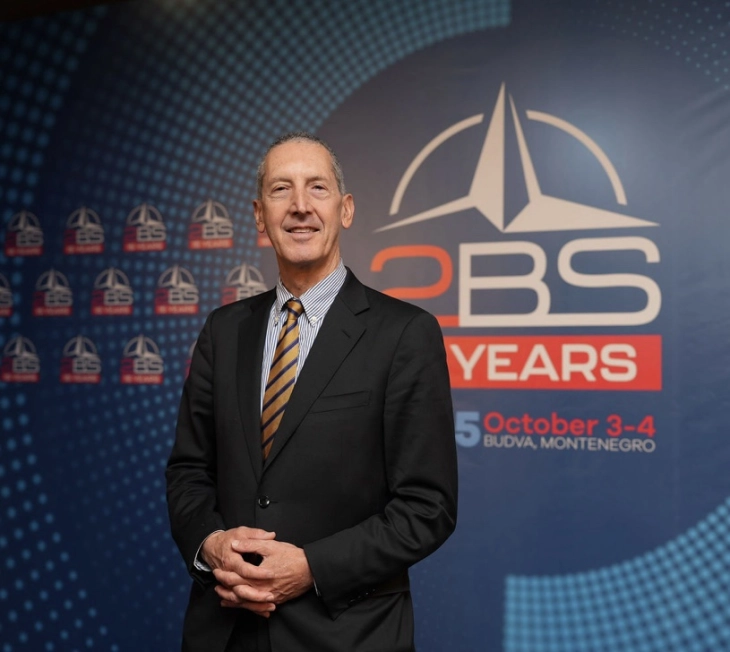
Podgorica, (MINA) – The European Union (EU) must take responsibility for the situation in the Western Balkans if it wants to be an actor on the international stage, said Edward P. Joseph, lecturer at the School of Advanced International Studies at Johns Hopkins University.
In an interview with the MINA News Agency on the sidelines of the 2BS Forum in Budva, he said that Montenegro’s EU membership is extremely important for both the EU and the country, stating that the biggest responsibility lies with Montenegro that should implement reforms, raise the level of political culture and demonstrate unity.
Commenting on the debate on how Europe can respond to major global challenges, Joseph pointed out that the Western Balkan region is especially important for the EU.
According to him, the EU plays an important role in resolving the crisis in Ukraine, but it is not within its power to address this crisis alone. “The reality is that in that they are dependent on the United States”.
“But here in the Balkans, the EU can and should stand up”, said Joseph, adding that this is exactly what the administration of US President Donald Trump expects.
When asked about the EU’s current approach towards the Western Balkans region, Joseph emphasized that he believes that the Union is not doing enough.
“The Balkans have never been a priority enough, and that’s a terrible mistake”, said Joseph, stressing that the region is part of Europe and therefore primarily EU’s responsibility.
“There have been times when the members of the European Union have sabotaged, I’m using that word deliberately, the interests of the region”, Joseph claimed, pointing to the example when France imposed new demands on North Macedonia despite the country changed its name under Bulgaria’s pressure.
When asked if this means that the Western Balkans is a kind of a test for the EU and an opportunity to assert itself internationally, Joseph answered in the affirmative.
According to him, one cannot talk about the “strategic autonomy”, mentioned by some European leaders recently, if they cannot tackle the problems in their own backyard.
As Joseph pointed out, it is feasible for the EU to influence the situation in the Western Balkans, because there are no countries like Russia here, no countries with nuclear weapons or a massive army, and no fossil fuel giants.
He added that Serbia is the biggest country in the region, but it does not have any of those capacities.
“If the EU cannot deal with the feasible problems, well, then how are we going to have our own projections in international sphere and China and all of this”, asked Joseph.
When asked what is the main obstacle for the EU to deal more effectively with the Western Balkans region, Joseph said that the main obstacle is the lack of will, but also long-term reliance on the US.
Joseph believes that the mass protests in Serbia test the government’s accountability to its citizens, which, as he reminded, is one of the core European values.
“It’s a test of values. And the European Union is failing this test”, said Joseph, adding that the EU should have stricter messages towards Serbia that citizens cannot be arrested or beaten.
When asked if the EU is in some way neutral towards the situation in Serbia, Joseph pointed out that the EU, unfortunately, sends contradictory messages, and the President of the European Commission, Ursula von der Leyen, should be more clear about the situation in Serbia.
He assessed that the EU compromised on this with Belgrade, such as the case with French interest regarding the purchase of Rafael fighter jets.
“There’s this fear, which also was a problem in Biden administration, that if we push Aleksandar Vucic too hard, then he will go with Russia”, stated Joseph.
Asked about Montenegrin membership in the EU and the importance of that step for the Union itself, he said that Montenegro’s membership in the EU is extremely important.
Joseph believes that the EU will accept Montenegro, although, as he pointed out, there is no guarantee, since there are always political games.
He referred to the influence of Serbia in Montenegro, stating that it is actually the influence of Vucic.
“He (Vucic) sees Montenegro’s accession to the EU as a threat to him, in a similar way that President of Russia Vladimir Putin sees Ukraine’s entry into the EU as a threat”, said Joseph.


