Kos: Montenegro needs to accelerate reform pace, particularly in the rule of law
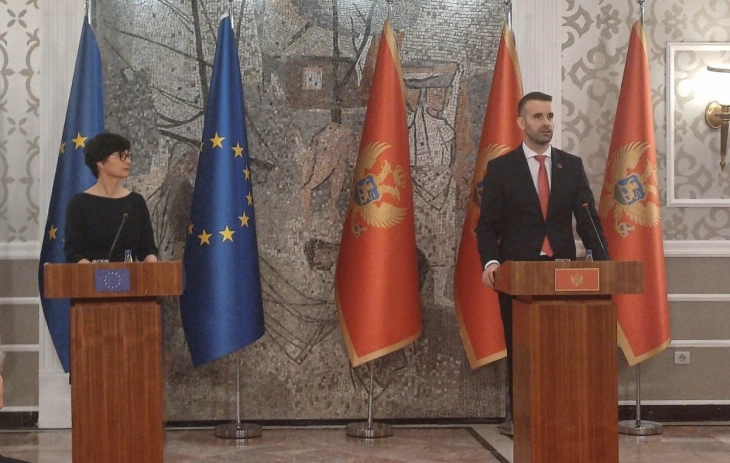
Podgorica, (MINA) - Progress on the EU path is not only reflected in the adoption and amendment of laws, but also in their quality and implementation, said European Commissioner for Enlargement Marta Kos, adding that Montenegro must speed up the reform pace, especially in the rule of law.
Speaking at the press conference with Prime Minister Milojko Spajic, she said that last year Montenegro made significant progress on its EU path, and now serves as a role model for the countries of the region, but that is yet a lot to be done, including some of the most challenging reforms.
Kos emphasized that institutions must be stable and that progress is not only reflected in the adoption and amendment of laws, but also in their quality and implementation.
“Your institutions must be stable and strong enough to guarantee democracy, the rule of law and human rights, as set out in the Copenhagen membership criteria”, Kos said.
She highlighted three priority areas for Montenegro, the first of which is accelerating reforms, and the second strengthening the rule of law where, as she said, the work is not yet finished.
“Each member state must have an independent judiciary, the capacity to fight both high-level corruption and organized crime, and must have independent media. We will never compromise on these issues”, said Kos.
The third priority, she added, refers to public support for the European path.
Kos emphasized that the EU path must be supported by all political parties, civil society and citizens.
She added that she discussed with Spajic the mechanisms that will ensure compliance with the rules even after the accession.
According to her, such mechanisms are important in light of experiences from previous enlargements, and the EU’s desire to ensure it can respond if a member state stops complying with common rules.
Kos emphasized that this initiative does not refer specifically to Montenegro, but will apply to all future EU members, but that Montenegro, as the most advanced country on the European path, could be the first to join the Union under such conditions.
Spajic said that intensive communication with the EC confirms Montenegro’s progress in the European integration process, adding that the country has a crucial year ahead.
“This year is crucial for us. The 20th anniversary of restoration of independence should be remembered for the fact that Montenegro enters a new era – the European era”, said Spajic, emphasizing the importance of symbolism and results.
According to him, the focus of the reforms remains on the rule of law and negotiation chapters 23 and 24.
Spajic said that Montenegro has 19 chapters left to close, but that many are 80 or 90 percent aligned with EU legislation.
He announced that the closing of new chapters can be expected in the coming period.
Responding to journalists’ questions, Spajic said that the reform processes are proceeding according to plan, but agreed that sometimes the pace must be accelerated.
He did not answer whether Europe Now Movement MPs will vote for the candidates for the Constitutional Court judges proposed by President Jakov Milatovic, but praised the work of that court over the past year or two.
Kos, responding to questions about the adoption of the laws on internal affairs and the National Security Agency, stated that the data protection provisions are not yet fully ligned with European rules, and that full harmonization will be necessary during the accession process.
Kos pointed out that she received assurances from Spajic that work is underway to resolve those issues and a decision on implementation of the law is expected soon.
She emphasized that the EC will closely monitor the implementation of the law, expecting all processes to be in line with European principles.
Asked about the ratification process and whether there are concerns about certain member states and their reactions, Kos said that based on polls, they see that there are different opinions in different states, but that in general the majority of European citizens support enlargement.
She clarified that the process of informing the public has already begun, both in candidate countries and in EU member states, adding that the EC encourages member states to be more present and visible in their countries in order to explain the enlargement process.
Kos pointed out that five countries are a special priority when it comes to public communication, but added that information campaign will be carried out in across all EU member states.