Ivanovic: We expect three intergovernmental conferences by August
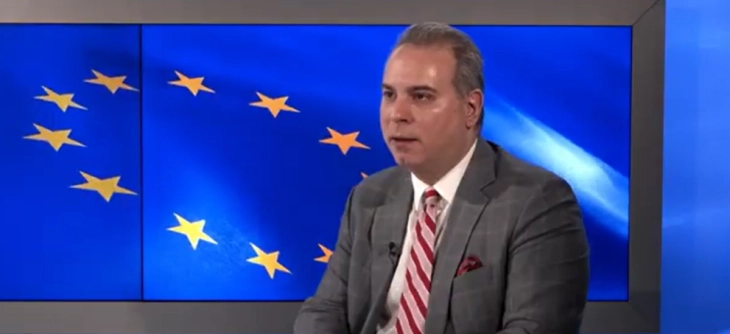
Podgorica, (MINA) – Montenegro’s accession to the European Union (EU) has become an irreversible process, said Deputy Prime Minister for Foreign and European Affairs Filip Ivanovic, adding that the government expects three intergovernmental conferences with the EU to be held by August.
In an interview with the MINA News Agency, Ivanovic said that intergovernmental conferences between Montenegro and the EU are expected in May and June, but he could not specify how many chapters would be closed.
“It is difficult to assess this, because we can say that we have a certain number of chapters ready, but the European Commission may not be able to verify all of them, and in principle that is not known until practically the very last moment,” Ivanovic said.
He added that one intergovernmental conference could also be expected in July.
“There are plans to hold another intergovernmental conference in July, at the beginning of the Irish presidency. I obviously could not speculate on the number of chapters, but it will certainly be more than two or three,” Ivanovic said.
He said that the establishment of the working party for drafting Montenegro’s accession treaty is an even more important development than the positive Interim Benchmark Assessment Report.
“So, when everything is taken into account, the moment of starting the drafting of the accession treaty is the biggest progress and the most significant moment in the entire negotiation process between Montenegro and the EU. Not because it is an administrative step, but because it shows, and I can freely interpret it that way, that Montenegro’s accession to the EU has become an irreversible process,” Ivanovic said.
He said that criticism from part of the public regarding the rapid adoption of certain laws in parliament may be justified, but “the situation is what it is”.
Ivanovic noted that all that needs to be done on the EU path, including adoption of laws, numerous appointments, constitutional amendments, requires certain solutions to be adopted without excessive debate.
“In other words, as quickly as possible, in order to allow the European Commission and its experts to review and verify everything, so that it can be placed on the agenda of the intergovernmental conference,” he added.
He said that similar situations occurred in other countries that are now EU members when they were candidates.
“So, none of this is unknown, none of this is new, and none of this is specific to Montenegro,” Ivanovic added.
He believes that the opposition left parliamentary bodies because they saw that Montenegro is making significant progress towards membership.
“They saw that the goals set by the government and the parliamentary majority are being achieved. And we have reached a situation, about a year before regular parliamentary elections, where certain political actors want to position themselves in the best possible way on the political scene,” Ivanovic said.
Asked whether it is acceptable for Montenegro to join the EU under certain new conditions, Ivanovic said that this debate has been ongoing for years.
“This relates to the decision-making method, that is, whether to keep the unanimous system as it is now or introduce a system of so-called qualified majority voting. That debate is ongoing and divided between large and small EU member states,” he said.
He added that smaller EU states advocate maintaining unanimity, as it guarantees them equal status in decision-making regardless of their geographical or economic power.
“How that debate will be resolved, and whether it will be resolved before Montenegro’s accession or before some other potential new member states join, is a question for the EU, and we cannot provide answers in that regard,” Ivanovic said.
He noted that, given the current situation regarding Montenegro, it is impossible at this moment to admit a new member state and deny it voting rights or veto power, as the EU’s legal framework does not allow for that.
“What is being discussed, and what we will see in the coming months as the working group on the accession treaty advances, are certain safeguard mechanisms and transitional periods that will be incorporated into the accession treaty,” he added.
Asked about negotiations between Montenegro and Croatia on open bilateral issues, Ivanovic said it was agreed that talks would be held continuously and that the public would be informed about outcomes rather than the process.
“Therefore, as I said, the talks are going well, they are ongoing, and they are conducted in good faith. As I have mentioned several times, we are very close to resolving certain issues raised by Croatia, which, I must also emphasise, are not new. They are not from five or six years ago, but from 30 or 35 years ago,” he said.
He added that “someone else opened those issues, and it is up to us to close them, and I am confident that we will succeed”.
According to Ivanovic, there is good will on the Montenegrin side.
“There is, I would say, good will on the Croatian side as well. And perhaps it should also be mentioned that Chapter 31 has not been closed because Croatia did not give the green light. However, we are not talking about any blockage or slowing down of the overall European integration process, because as you can see, Croatia is giving the green light for all other chapters that we have been closing continuously since December 2024,” he said.
He added that the public will be informed of the outcome once certain matters are agreed and resolved.
Asked what 1 January 2027 would look like if all chapters are not closed, Ivanovic said that, as far as Montenegro is concerned, everything will be ready for the closure of all chapters by the end of the year.
Asked whether he expects attempts to sabotage Montenegro in the final phase of negotiations, Ivanovic said that not everyone will be pleased.
“Sabotage may be a strong word, but I expect that not everyone will be pleased. As is the case now, both domestically and abroad,” he said.
He said the government is closely monitoring the situation.
“And not only the government; the media also have an important role to play, but citizens must also be aware that not all narratives circulated publicly, whether through social media or certain statements, are accurate,” he added.
He cited as an example the information about a supposed EU requirement involving dismissal of 25 per cent of employees in the state administration, noting that it had been denied both by the EU Delegation and the government.
Asked whether he believes the state apparatus is too large, Ivanovic said he believes it needs to be more efficient.
VIDEO SERVIS


