CDT analysis: Montenegro more inclusive than in 2006, civic model still insufficiently consolidated
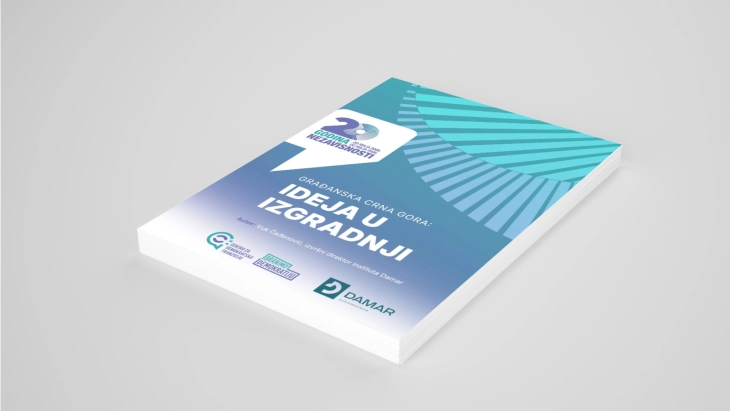
Podgorica, (MINA) – Montenegro is today more open and inclusive than it was in 2006, but it has not yet sufficiently consolidated the civic model to be resistant to political and identity-based regressions, according to the analysis by the Center for Democratic Transition (CDT).
The analysis, authored for CDT by Damar Institute director Vuk Cadjenovic, states that the civic state and open society are present in many declarations, party programs and that political elites frequently mention them in public speeches.
“However, 20 years after the restoration of independence, it is legitimate to ask how open and civic Montenegro actually is”, reads the analysis, prepared as part of the dialogue initiated by the CDT with the Damar Institute to mark Montenegro’s 20th independence anniversary.
The document points out that the position of women is one of the clearer indicators that the Montenegrin political space has at least partially opened up.
It is stated that the increase in women’s participation can be seen in the Parliament of Montenegro, that quotas and institutional mechanisms have opened doors that party selection and political culture were not ready to open, but that the resistance of patriarchal patterns is still present.
A similar pattern, as highlighted in the analysis, can also be observed regarding the position of ethnic minority communities.
“In the 2006-2023 period, the representation of ethnic minority parties in the Parliament of Montenegro varied, but the year 2023 marked the maximum, with a total of ten seats won by ethnic minority lists and parties – six by Bosniak parties, three by Albanian parties and one by a Croatian party”, the analysis reads.
However, it is pointed out that affirmative representation is not the same as depolarization.
The openness of a society, as stated, is not measured only by who is formally represented in the institutions, but also by how the society perceives different groups.
“On a scale from 0 to 1, where higher values mean a greater negative social distance, the distance towards Albanians fell from 0.471 in 2006 to 0.383 in 2016 and 0.292 this year”, Cadjenovic states in the analysis.
According to him, the social distance towards Roma remains very high in 2006 and 2016 (0.605), but this year it fell to 0.362.
Cadjenovic said that, in contrast, social distance towards LGBT people remains almost constantly high – 0.57 in 2006, 0.57 in 2016 and 0.561 this year.


